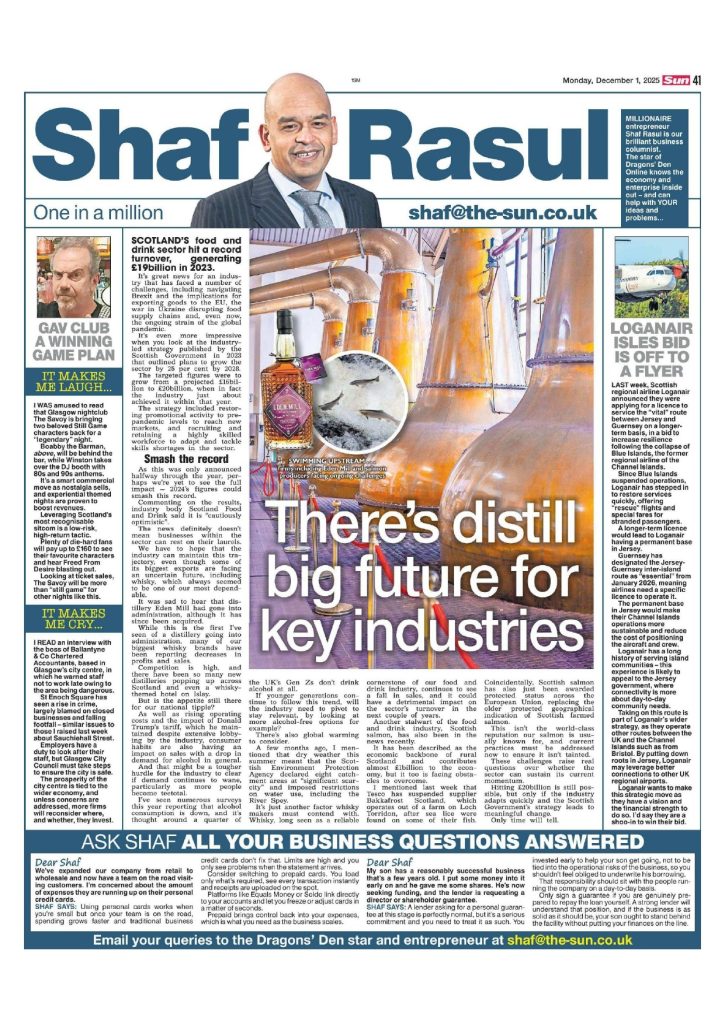
SCOTLAND’S food and drink sector hit a record turnover, generating £19billion in 2023.
It’s great news for an industry that has faced a number of challenges, including navigating Brexit and the implications for exporting goods to the EU, the war in Ukraine disrupting food supply chains and, even now, the ongoing strain of the global pandemic.
It’s even more impressive when you look at the industry-led strategy published by the Scottish Government in 2023 that outlined plans to grow the sector by 25 per cent by 2028.
The targeted figures were to grow from a projected £16billion to £20billion, when in fact the industry just about achieved it within that year.
The strategy included restoring promotional activity to pre-pandemic levels to reach new markets, and recruiting and retaining a highly skilled workforce to adapt and tackle skills shortages in the sector.
Smash the record
As this was only announced halfway through the year, perhaps we’re yet to see the full impact. 2024’s figures could smash this record.
Commenting on the results, industry body Scotland Food and Drink said it is “cautiously optimistic”.
The news definitely doesn’t mean businesses within the sector can rest on their laurels. We have to hope that the industry can maintain this trajectory, even though some of its biggest exports are facing an uncertain future, including whisky, which always seemed to be one of our most dependable.
It was sad to hear that distillery Eden Mill had gone into administration, although it has since been acquired.
While this is the first I’ve seen of a distillery going into administration, many of our biggest whisky brands have been reporting decreases in profits and sales.
Competition is high, and there have been so many new distilleries popping up across Scotland and even a whisky-themed hotel on Islay.
But is the appetite still there for our national tipple?
As well as rising operating costs and the impact of Donald Trump’s tariff, which he maintained despite extensive lobbying by the industry, consumer habits are also having an impact on sales with a drop in demand for alcohol in general.
And that might be a tougher hurdle for the industry to clear if demand continues to wane, particularly as more people become teetotal.
I’ve seen numerous surveys this year reporting that alcohol consumption is down, and it’s thought around a quarter of the UK’s Gen Zs don’t drink alcohol at all.
If younger generations continue to follow this trend, will the industry need to pivot to stay relevant, by looking at more alcohol-free options for example?
There’s also global warming to consider.
A few months ago, I mentioned that dry weather this summer meant that the Scottish Environment Protection Agency declared eight catchment areas at “significant scarcity” and imposed restrictions on water use, including the River Spey.
It’s just another factor whisky makers must contend with.
Whisky, long seen as a reliable cornerstone of our food and drink industry, continues to see a fall in sales, and it could have a detrimental impact on the sector’s turnover in the next couple of years.
Another stalwart of the food and drink industry, Scottish salmon, has also been in the news recently.
It has been described as the economic backbone of rural Scotland and contributes almost £1billion to the economy, but it too is facing obstacles to overcome.
I mentioned last week that Tesco has suspended supplier Bakkafrost Scotland, which operates out of a farm on Loch Torridon, after sea lice were found on some of their fish.
Coincidentally, Scottish salmon has also just been awarded protected status across the European Union, replacing the older protected geographical indication of Scottish farmed salmon.
This isn’t the world-class reputation our salmon is usually known for, and current practices must be addressed now to ensure it isn’t tainted.
These challenges raise real questions over whether the sector can sustain its current momentum.
Hitting £20billion is still possible, but only if the industry adapts quickly and the Scottish Government’s strategy leads to meaningful change.
Only time will tell.
LOGANAIR ISLES BID IS OFF TO A FLYER
Last week, Scottish regional airline Loganair announced they were applying for a licence to service the “vital” route between Jersey and Guernsey on a longer-term basis, in a bid to increase resilience following the collapse of Blue Islands, the former regional airline of the Channel Islands.
Since Blue Islands suspended operations, Loganair has stepped in to restore services quickly, offering “rescue” flights and special fares for stranded passengers.
A longer-term licence would lead to Loganair having a permanent base in Jersey.
Guernsey has designated the Jersey–Guernsey inter-island route as “essential” from January 2026, meaning airlines need a specific licence to operate it.
The permanent base in Jersey would make their Channel Islands operations more sustainable and reduce the cost of positioning the aircraft and crew.
Loganair has a long history of serving island communities. This experience is likely to appeal to the Jersey government, where connectivity is more about day-to-day community needs.
Taking on this route is part of Loganair’s wider strategy, as they operate other routes between the UK and the Channel Islands such as from Bristol. By putting down roots in Jersey, Loganair may leverage better connections to other UK regional airports.
Loganair wants to make this strategic move as they have a vision and the financial strength to do so. I’d say they are a shoo-in to win their bid.
GAV CLUB A WINNING GAME PLAN
I WAS amused to read that Glasgow nightclub The Savoy is bringing two beloved Still Game characters back for a “legendary” night.
Boabby the Barman, above, will be behind the bar, while Winston takes over the DJ booth with 80s and 90s anthems.
It’s a smart commercial move as nostalgia sells, and experiential themed nights are proven to boost revenues.
Leveraging Scotland’s most recognisable sitcom is a low-risk, high-return tactic.
Plenty of die-hard fans will pay up to £160 to see their favourite characters and hear Freed From Desire blasting out.
Looking at ticket sales, The Savoy will be more than “still game” for other nights like this.
It Made Me Weep
I READ an interview with the boss of Ballantyne & Co Chartered Accountants, based in Glasgow’s city centre, in which he warned staff not to work late owing to the area being dangerous.
St Enoch Square has seen a rise in crime, largely blamed on closed businesses and falling footfall. Similar issues to those I raised last week about Sauchiehall Street.
Employers have a duty to look after their staff, but Glasgow City Council must take steps to ensure the city is safe.
The prosperity of the city centre is tied to the wider economy, and unless concerns are addressed, more firms will reconsider where, and whether, they invest.